
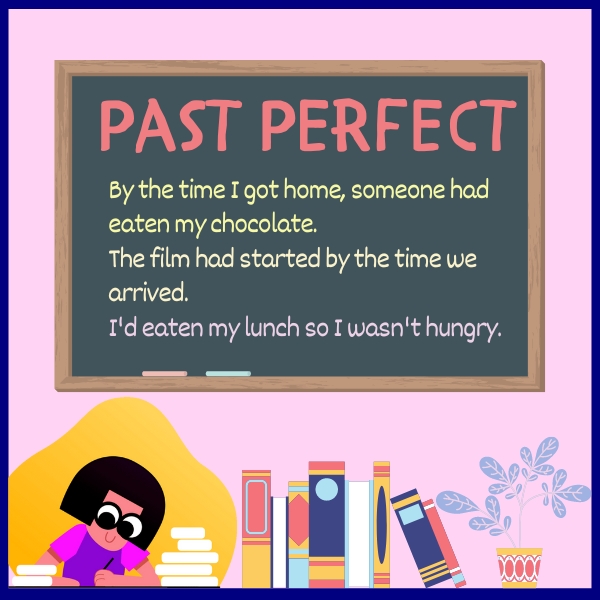

Past Perfect Tense
We use a Past Perfect tense when we want to say an action finished before another action.
To form the Past Perfect we need the auxiliary Verb To Have (past tense) and a main verb (past participle). This is usually verbs ending in ed, unless it’s an irregular verb:
Regular verbs: had + waited, had + walked, had + looked
Examples: I had waited…, You had walked…, She had looked…
Irregular Verbs: had + eaten, had + bought, had + done
Examples: I had eaten…, You had bought…, She had done…
You can contract the Past Perfect clause by combining the subject and Verb to Have (had):
I’d waited…, You’d walked…, She’d eaten…, They’d done…
Using Past Perfect Tense
Here’s a breakdown of each time we can use the Past perfect tense…
To talk about a finished action before another action
When you’re talking about some action that happened in the past and want to discuss another action that happened even earlier.
This form will usually be part of at least a 2 clause sentence. The earlier happening clause will be the Past Perfect, and the action that happened after will usually be Past Simple.
When we arrived, the film had started.
Susan had gone by the time Peter got to the party.
I‘d eaten dinner so I wasn’t hungry.
Notice how each of the Past perfect clause actions happened before the time of the past simple action.
Use in Third Conditionals
We use the Past Perfect when we use a third conditional to express an imaginary result of something that didn’t happen.
The Past Perfect clause is used in the condition (if) clause, and the other clause will use would have and past participle.
The verb forms of both clauses: If… past perfect, …would + have + past participle… The if clause can go first or second, it makes no difference.
If I had studied, I would have passed my exam.
I would have gotten a faster time if I had trained properly.
If they had waited another 5 minutes, I wouldn’t have missed them.
Click here for more on Conditionals in English language.
This form of sentence can also be used with wish instead of if. It generally has the same meaning. With this form, you have to put the wish clause first.
I wish I had studied, I would have passed my exam.
I wish I had trained properly, I would have gotten a faster time.
I wish they had waited another 5 minutes, I wouldn’t have missed them.